Friday, June 29, 2012

Sunday, May 20, 2012
May 20, 2012
MONTH NINE:

St. Bridget (sometimes called Birgitta) was born about the year 1303. When she was only 7 years old, Bridget had a vision in which our Lady placed a crown on her head, and when she was 10, after a sermon on the Passion, she saw in a dream Christ wounded and bleeding. These two experiences seem to have been the formative ones of her life.
Her mother died in 1314, and she lived with an aunt until, in 1316, obediently but against her inclination, she married Ulf Gudmarsson. They had four boys and four girls. Two of the boys died young; Karl, the eldest, was worldly but devoted to our Lady; Birger, the second, though married, later became his mother's companion and brought her body home to Sweden from Rome to be buried. Three of the girls married: Merita and Cecilia staying in Swedish society, while Catherine lost her husband and lived with her mother; the fourth, Ingebord, became a Cistercian.
Twenty-eight years after their marriage, Ulf died and Bridget went to live the penitential life she longed for near the Cistercian monastery at Alvastra. While three, she planned the Rule and Office of the order she was called to found but which she never saw in existence. After two years, in 1344, she went to Rome, where she died on July 23rd, 1373. Her canonization took place only eighteen years later, on October 7th, 1391.
St. Bridget had the gift of prophecy and worked many marvelous cures. Once widowed, she lived an ascetic life, eating very little, sleeping short hours, and praying continually. She followed a strict rule and practiced every possible kind of charitable work, even reducing herself to begging. She received constant inspirations which were either taken down by her chaplain and put into Latin, thus becoming known as her 'Revelations,' or took the form of letters to the succeeding popes, cardinals, and secular rulers of the day, telling them of their wickedness and how to reform their lives. Both in Sweden and in Rome she was either hated violently or loved as a saint. 'Strong and full of courage,' she was 'homely and kind and had a laughing face.'
COLORING PAGES:


OPENING PRAYER/STORY:

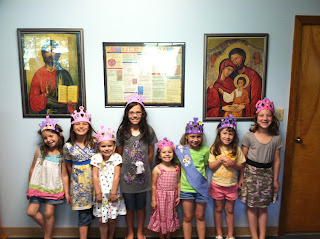
 CRAFT:

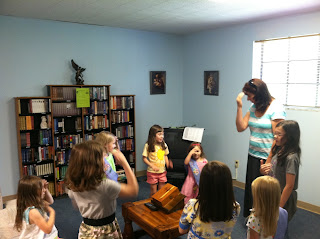
GAME:


It is hard to believe the year is coming to a close. We will be having an ice cream social to celebrate the success of Little Flowers of the South Hills.
The Narcissus - Truthfulness
"A kind mouth multiplies friends, and gracious lips prompt friendly greetings." ~Sirach 6:5
Saint Bridget of Sweden

St. Bridget (sometimes called Birgitta) was born about the year 1303. When she was only 7 years old, Bridget had a vision in which our Lady placed a crown on her head, and when she was 10, after a sermon on the Passion, she saw in a dream Christ wounded and bleeding. These two experiences seem to have been the formative ones of her life.
Her mother died in 1314, and she lived with an aunt until, in 1316, obediently but against her inclination, she married Ulf Gudmarsson. They had four boys and four girls. Two of the boys died young; Karl, the eldest, was worldly but devoted to our Lady; Birger, the second, though married, later became his mother's companion and brought her body home to Sweden from Rome to be buried. Three of the girls married: Merita and Cecilia staying in Swedish society, while Catherine lost her husband and lived with her mother; the fourth, Ingebord, became a Cistercian.
Twenty-eight years after their marriage, Ulf died and Bridget went to live the penitential life she longed for near the Cistercian monastery at Alvastra. While three, she planned the Rule and Office of the order she was called to found but which she never saw in existence. After two years, in 1344, she went to Rome, where she died on July 23rd, 1373. Her canonization took place only eighteen years later, on October 7th, 1391.
St. Bridget had the gift of prophecy and worked many marvelous cures. Once widowed, she lived an ascetic life, eating very little, sleeping short hours, and praying continually. She followed a strict rule and practiced every possible kind of charitable work, even reducing herself to begging. She received constant inspirations which were either taken down by her chaplain and put into Latin, thus becoming known as her 'Revelations,' or took the form of letters to the succeeding popes, cardinals, and secular rulers of the day, telling them of their wickedness and how to reform their lives. Both in Sweden and in Rome she was either hated violently or loved as a saint. 'Strong and full of courage,' she was 'homely and kind and had a laughing face.'
COLORING PAGES:


 |
| We had a little visitor this month:) |
OPENING PRAYER/STORY:
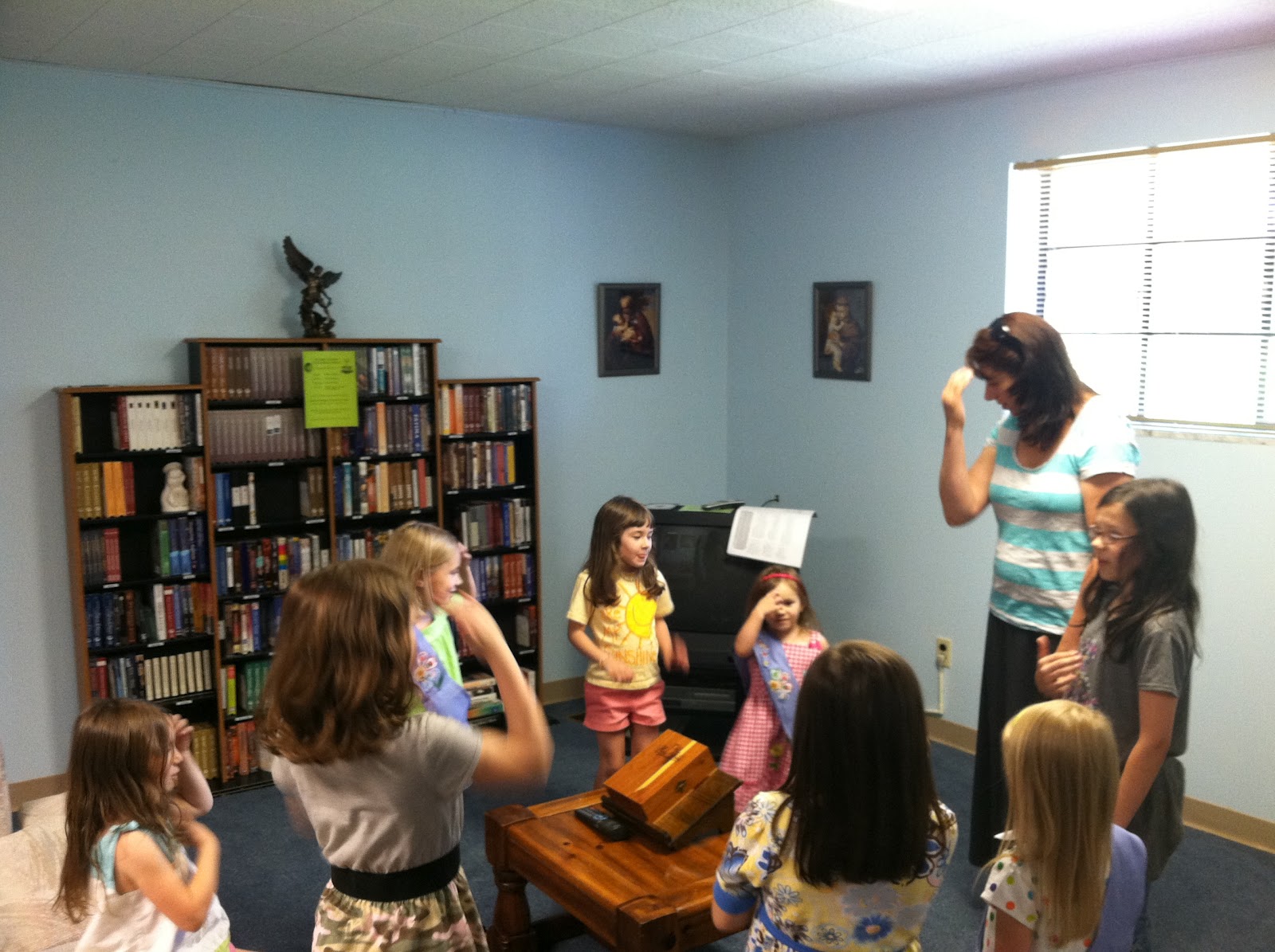


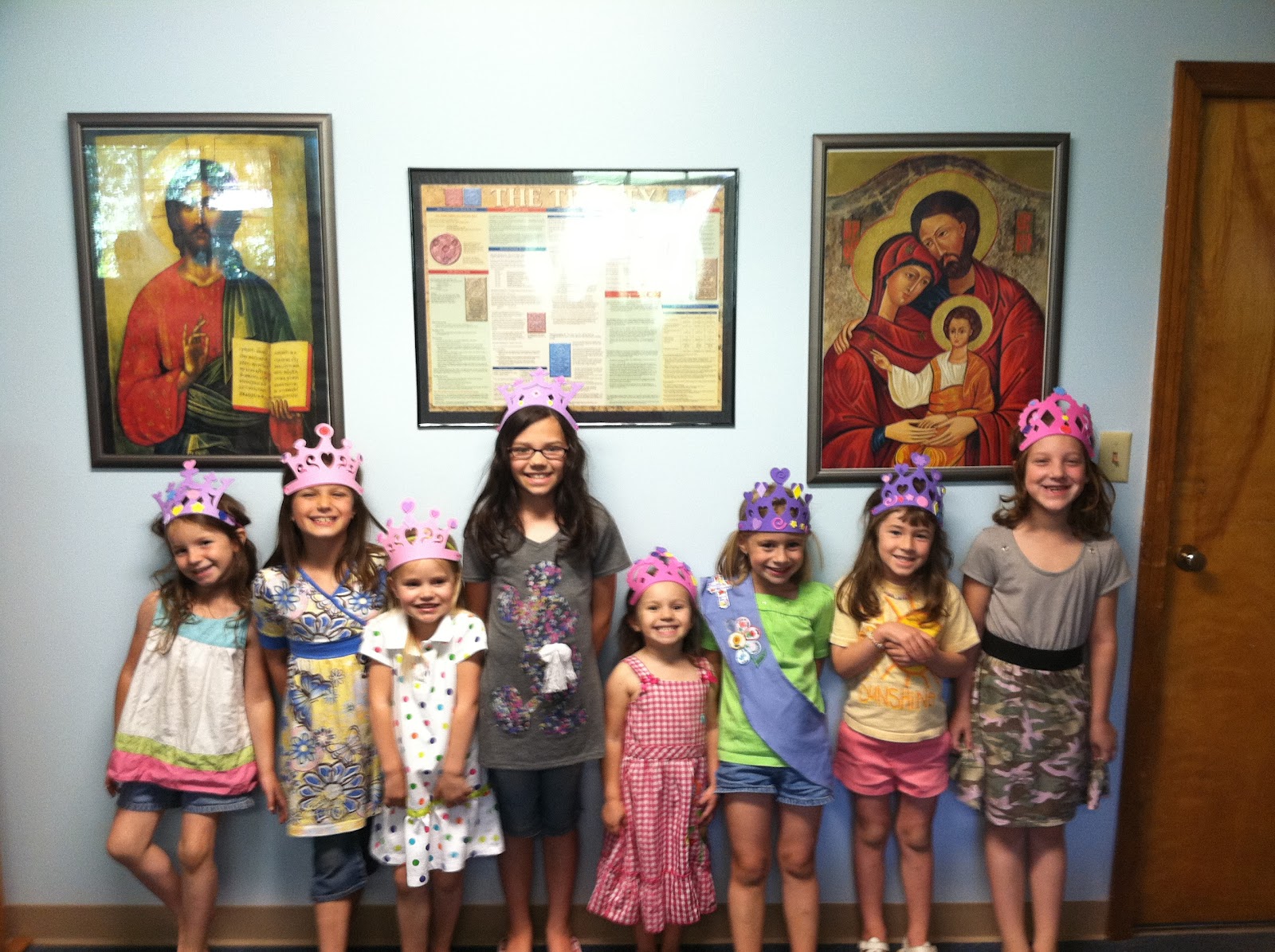
GAME:


It is hard to believe the year is coming to a close. We will be having an ice cream social to celebrate the success of Little Flowers of the South Hills.
Sunday, April 29, 2012
April 29, 2012
MONTH EIGHT:


OPENING PRAYER/STORY:


CRAFT:


SNACK:


GAME:

The Daffodil - Industry

"In the same way, faith, by itself, if it is not accompanied by action, is dead." ~James 2:17
Saint Frances Xavier Cabrini

St. Frances Xavier Cabrini, Virgin (Feast day November 13) St. Frances was born in Lombardi, Italy in 1850, one of thirteen children. At eighteen, she desired to become a Nun, but poor health stood in her way. She helped her parents until their death, and then worked on a farm with her brothers and sisters.
One day, a priest
asked her to teach in a girls' school and she stayed for six years. At
the request of her Bishop, she founded the Missionary Sisters of the
Sacred Heart to care for poor children in schools and hospitals. Then at the urging of Pope Leo XIII she came to the United States with six nuns in 1889 to work among the Italian immigrants.
Filled with a deep trust in Godand endowed with a wonderful administrative ability, this remarkable woman soon founded schools, hospitals, and orphanages in this strange land
and saw them flourish in the aid of Italian immigrants and children. At
the time of her death, at Chicago, Illinois on December 22, 1917, her institute numbered houses in England, France,
Spain, the United States, and South America. In 1946, she became the
first American citizen to be canonized when she was elevated to
sainthood by Pope Pius XII. St. Frances is the patroness of immigrants.
COLORING PAGES:


OPENING PRAYER/STORY:


CRAFT:


SNACK:


GAME:

Sunday, March 25, 2012
March 25, 2012
MONTH SEVEN:


 Just 2 more months to go for this year of Little Flowers. We can't wait to start planning for next year!

The Violet - Humility

"If the people who are called by My name, will humble themselves and pray and seek my face and turn from their wicked ways, then will I hear from heaven and will forgive their sin and will heal their land." ~2 Chron 7:14
Saint Catherine Laboure

St. Catherine Laboure, virgin, was born on May 2, 1806. At an early age she entered the community of the Daughters of Charity, in Paris, France. Three times in 1830 the Virgin Mary appeared to St. Catherine Laboure, who then was a twenty-four year old novice.
On July 18, the first apparition occurred in the community's mother house. St. Catherine beheld a lady seated on the right side of the sanctuary. When St. Catherine approached her, the heavenly visitor told her how to act in time of trial and pointed to the altar as the source of all consolation. Promising to entrust St. Catherine with a mission which would cause her great suffering, the lady also predicted the anticlerical revolt which occurred at Paris in 1870.
On November 27, the lady showed St. Catherine the medal of the Immaculate Conception, now universally known as the "Miraculous Medal." She commissioned St. Catherine to have one made, and to spread devotion to this medal. At that time, only her spiritual director, Father Aladel, knew of the apparitions. Forty-five years later, St. Catherine spoke fully of the apparitions to one of her superiors. She died on December 31, 1876, and was canonized on July 27, 1947. Her feast day is November 28.
COLORING PAGES:


OPENING PRAYER AND STORY:


MIRACULOUS MEDAL LEAFLETS:


SNACK AND GAME:


Sunday, February 26, 2012
February 26, 2012
MONTH SIX:


Cecilia was a Roman noblewoman who had given her heart to Christ. Under the rich clothes worn by women of high class, Cecilia wore a rough shirt that caused her suffering. She wanted to be able to offer this sacrifice to Jesus, whose bride she intended to be.
But Cecilia's parents gave her in marriage to a young pagan noble, Valerian of Trastevere. Celia is considered the patroness of music because during the wedding celebration, the lovely bride sat apart, singing a hymn of love to God in her heart and praying for his help.
When she and Valerian, her husband, were alone, she gathered up courage and said to him: "I have a secret to tell you. You must know that I have an angel of God watching over me. If you let me keep my promise to be Christ's bride only, my angel will love you as he loves me."
Valerian was surprised and said kindly, "Show me this angel. If he comes from God, I will do as you wish."
Cecilia said, "If you believe in the one true God and receive the waters of Baptism, then you will see my angel." Valerian went to Bishop Urban and was received with joy. After he had professed his belief in the Christian religion, he was baptized and returned to St. Cecilia. There by the saint's side, the young man saw the splendid angel.
The angel placed a crown on each of their heads, and offered Valerian a favor and Valerian asked that his brother also be baptized.
Valerian's brother, Tiburtius, learned of the Christian faith from Cecilia. She spoke so beautifully of Jesus that before long, he too was baptized. Together the two brothers performed many works of charity and mercy, like burying dead Christian martyrs.
When they were arrested for being Christians, they went bravely to death rather than give up their new faith in Jesus. St. Cecilia lovingly buried their bodies, before she too was arrested.
She even converted the officers who tried to make her sacrifice to false gods. When she was put into a fire, it did not harm her. Then they tried to suffocate her and finally, a man was sent to her house to behead her.
He struck her neck three times, but Cecilia did not die immediately. She lay on the floor unable to move. Yet by holding out three fingers of one hand, and one of the other, she still professed her belief in the Blessed Trinity.
When her tomb was opened about one thousand five hundred years later in Rome, her body was still found perfect and incorrupt.
COLORING PAGES:


OPENING PRAYER AND STORY:


LEARNING ABOUT PIETY:


SNACK TIME:


CRAFT AND GAME:





The girls are really starting to form some awesome friendships now. What a great group!


The Forget-Me-Not - Piety

"I know You can do all things, and that no purpose of yours can be hindered" ~Job 42:2
Saint Cecilia

Cecilia was a Roman noblewoman who had given her heart to Christ. Under the rich clothes worn by women of high class, Cecilia wore a rough shirt that caused her suffering. She wanted to be able to offer this sacrifice to Jesus, whose bride she intended to be.
But Cecilia's parents gave her in marriage to a young pagan noble, Valerian of Trastevere. Celia is considered the patroness of music because during the wedding celebration, the lovely bride sat apart, singing a hymn of love to God in her heart and praying for his help.
When she and Valerian, her husband, were alone, she gathered up courage and said to him: "I have a secret to tell you. You must know that I have an angel of God watching over me. If you let me keep my promise to be Christ's bride only, my angel will love you as he loves me."
Valerian was surprised and said kindly, "Show me this angel. If he comes from God, I will do as you wish."
Cecilia said, "If you believe in the one true God and receive the waters of Baptism, then you will see my angel." Valerian went to Bishop Urban and was received with joy. After he had professed his belief in the Christian religion, he was baptized and returned to St. Cecilia. There by the saint's side, the young man saw the splendid angel.
The angel placed a crown on each of their heads, and offered Valerian a favor and Valerian asked that his brother also be baptized.
Valerian's brother, Tiburtius, learned of the Christian faith from Cecilia. She spoke so beautifully of Jesus that before long, he too was baptized. Together the two brothers performed many works of charity and mercy, like burying dead Christian martyrs.
When they were arrested for being Christians, they went bravely to death rather than give up their new faith in Jesus. St. Cecilia lovingly buried their bodies, before she too was arrested.
She even converted the officers who tried to make her sacrifice to false gods. When she was put into a fire, it did not harm her. Then they tried to suffocate her and finally, a man was sent to her house to behead her.
He struck her neck three times, but Cecilia did not die immediately. She lay on the floor unable to move. Yet by holding out three fingers of one hand, and one of the other, she still professed her belief in the Blessed Trinity.
When her tomb was opened about one thousand five hundred years later in Rome, her body was still found perfect and incorrupt.
COLORING PAGES:


OPENING PRAYER AND STORY:


LEARNING ABOUT PIETY:


SNACK TIME:


CRAFT AND GAME:


The girls are really starting to form some awesome friendships now. What a great group!


Subscribe to:
Posts (Atom)